Utrecht University Library, 2 September 2026
(Robin Koch, Leiden University, PhD candidate LangPro)
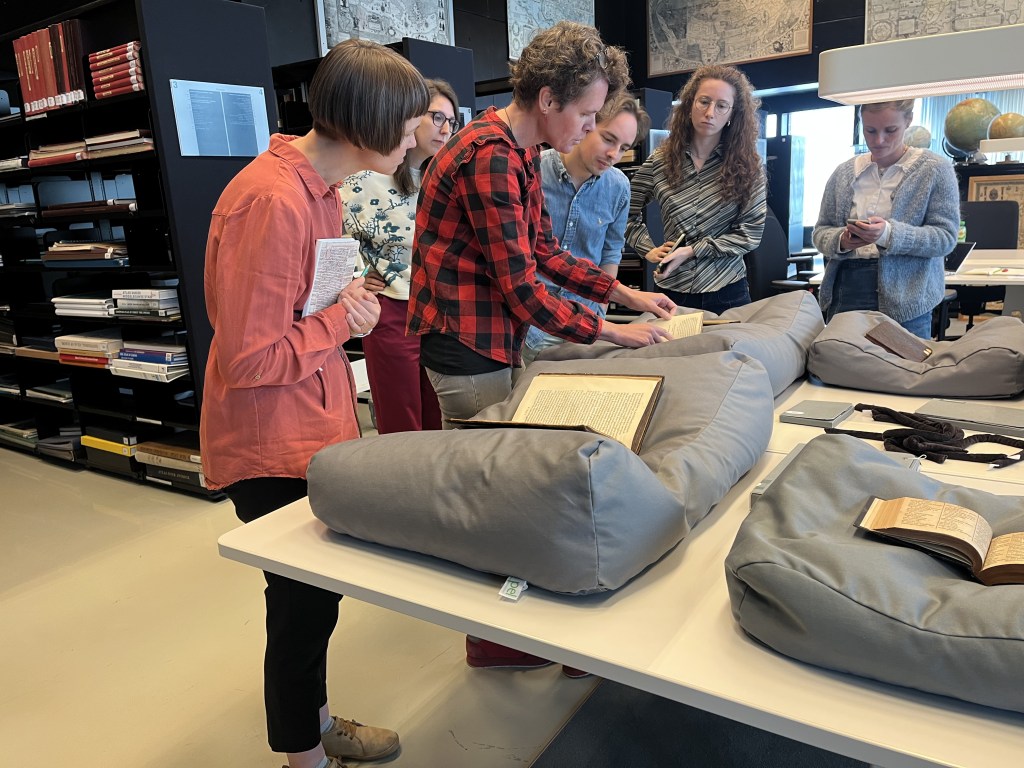
Bringing together multidisciplinary scholars, with the added benefit of access to primary source material relating to each of their fields, led to fruitful discussion in the Utrecht University Library. Within the map room of the library, we were introduced to various printed works ranging from 15th century incunabulae to 17th century works, and most notably in a great array of languages. This multilingualism found in the printed works reflected the situation in the Low Countries during the early modern period. Especially the multilingual vocabularies (containing Dutch, German, English, French, Latin, Spanish and Italian) were impressive, and gave rise to questions of the actors behind these cultural products and their (intended) use cases.
The first panel fittingly focused on authors, printers and their publication strategies. Alisa van de Haar presented on Jan van der Noot, an Antwerpian poet in English exile during the Dutch uprising. A convolute of his works was available for viewing afterwards. Pauline Bobichon’s presentation in the same panel ended in an interesting discussion on a unique type of oblong print that was used by printer Willem Vorsterman around 1520 to increase the legibility of his
trilingual vocabulary livre des métiers.
![Mark of ownership to Joeffrou Floris van Jutfaes weduwe. Source: Utrecht University Library, Rariora S. qu. 377, Historie van Die Seven Wise Mannen van Romen. [Delff]: [Jan Jacobszoon van der Meer], 1483. https://utrechtuniversity.on.worldcat.org/oclc/66822676](https://erclangpro.com/wp-content/uploads/2026/09/img_7650.jpg?w=768)
The second and third panel respectively treated ‘Translations and Their Mediators’ and ‘Multilingual Entanglements in Production and Reception’. Carlotta Posth’s lecture on the Pèlerinage de vie humaine further established the difficulty that can come with trying to ascertain the actors behind these products. Rita Schlusemann joined us online, presenting on Dutch editions of the Seven Sages of Rome, one of which present in the room (see the image). Finally, Rozanne Versendaal and Jelmar Hugen closed, leading to the concluding remarks where we engaged in a discussion on the concept of ‘writing’ as opposed to ‘rewriting’.
To summarize, the joint presence of the discussed works and multilingual experts from different disciplines allowed not only new questions to arise, but also to learn how to approach the sources in terms of (physical) form and contents.
With special thanks to the ERC, the University of Würzburg, and Utrecht University.
 LangPro Homepage
Leave a comment