Alisa van de Haar (Leiden University, PI LangPro)
Language skills could be an important source of social and financial capital in early modern Europe. This is clearly illustrated by the case of Magdalena Valery, who, as both a woman and a migrant, was doubly disadvantaged in early modern society, yet cleverly exploited her linguistic expertise to overcome her unfavourable position and become an entrepreneur and published author. Although she was, in some sense, an exceptional case since relatively few women managed to have their writings published in this period, tracing her professional choices sheds light on the opportunities and strategies available to marginalized individuals seeking to use their language proficiency to gain both income and social standing.
Magdalena (Madeleine) Valery was born around 1573, shortly after the St Bartholomew’s Day Massacre made painfully clear that France was no longer a safe place for Huguenots (French Protestants) including Valery’s parents. Her father, a notary, and her mother decided to move to the Low Countries and settled in Middelburg, in Zeeland. Valery was raised bilingually and explains in her published work that she attended French-language schools in Bruges and Antwerp. However, as the Dutch Revolt made the situation in the Southern Low Countries increasingly unsafe, she moved again, this time to Holland, settling first in Hoorn and finally, around 1599, in Leiden.
When Valery arrived in Leiden as a young woman in her twenties who had already moved at least three times, she was in a disadvantaged position. Nevertheless, she used her excellent command of French to her advantage. Proficiency in French was in high demand in the Northern Low Countries in the sixteenth century, as it functioned as a language of international commerce and diplomacy as well as an important administrative language. Recognizing this demand, Valery requested and obtained permission from the Leiden city council to open her own school for girls, where she promised ‘besides good manners, honourability, and modesty, to instruct in the French language as well as to teach perfect Dutch writing, arithmetic, and various handicrafts’. Her bilingual skills thus enabled her to become an entrepreneur and run a school. Valery married Thomas Edelingh, himself a schoolmaster. However, she managed the school independently, and the request to open it contains only her name. Her daughter, Hester, eventually joined her there as a teacher.
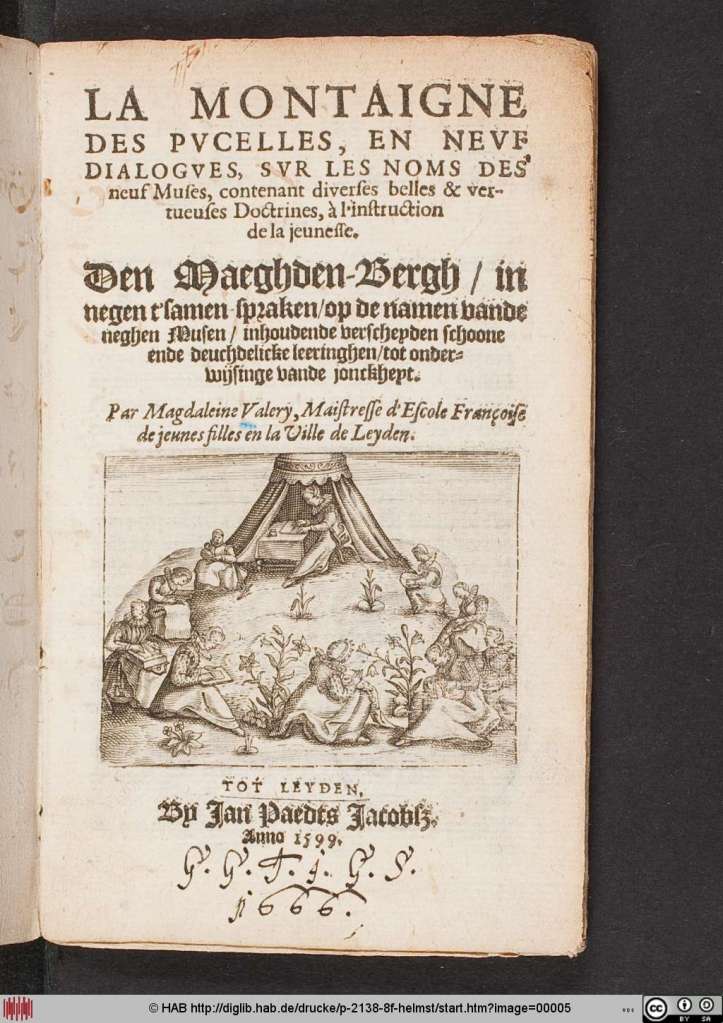
Valery’s conscious and deliberate use of her linguistic capital becomes even clearer in her next step: to attract pupils to her school, she published a bilingual schoolbook bearing the name of her school, Montaigne des Pucelles (Mountain of Maidens, referring to the mythological Mount Helicon). Of this book, only one copy is known to survive. It reveals a clear linguistic and cultural promotional strategy. The work is a bilingual dialogue book containing Dutch and French versions of conversations between fictional schoolgirls named after the Muses and the schoolmistress Valery herself. The teacher in the work thus promises one of the girls: ‘Well, my daughter, I will teach you in time: first to read well and perfectly both printed and written letters, and afterwards to write well, so that your parents’ money will not be spent wrongly’.
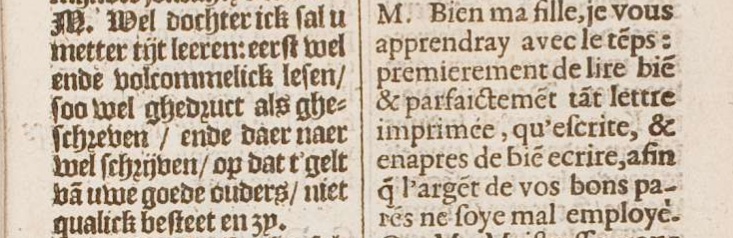
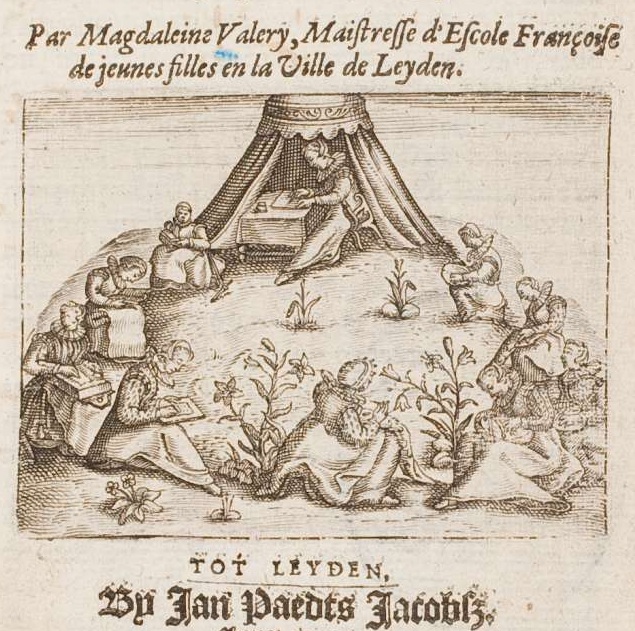
Through this publication, Valery not only showcased her command of Dutch and French, but also demonstrated her familiarity with prestigious classical literature, as well as her pedagogical ideas and skills. The booklet was printed in different typefaces: a Gothic blackletter for Dutch and a Roman type for French. Its title page contains an engraving apparently made specifically for this publication. This book project must thus have been an expensive undertaking, to which Valery likely contributed financially. Writing and printing it was a deliberate commercial decision, and she clearly sought to maximize its promotional value. The schoolbook contains a printed dedication in French to the magistrates of Leiden, in which Valery explains her background, her teaching ideals, and her reasons for founding her girls’ school: Leiden, now home to a university for young men, was in great need of high-quality education for young women. The sole surviving copy even includes a handwritten poem in Dutch signed by Valery, evidence that she presented it personally in order to expand or strengthen her professional and social network.
Magdalena Valery was thus able to establish herself in the early modern language sector as a migrant woman, but it is clear that this required careful professional decisions. Not only did she have to invest in teaching materials and a suitable location – found at the intersection of the Hogewoerd and the Hooigracht, along the water – she also had to request permission from the city council to open her school. As a newcomer to Leiden, she moreover needed a carefully planned promotional strategy to demonstrate her skills and articulate her vision of education, as well as to navigate the delicate issue of religion and attract students. Her investment in her schoolbook appears to have paid off: her will indicates that she died relatively well off, in late 1625 or early 1626.
Further reading
Dietz, F., Lettering Young Readers in the Dutch Enlightenment: Literacy, Agency and Progress in Eighteenth-Century Children’s Books (Basingstoke: Palgrave Macmillan, 2021), pp. 211-7.
Gemeente-archief Leiden, Secretarie-archief 1575-1851, nr. 9253, f. 64r-v.
Haar, A. van de, ‘Van “nimf” tot “schoolvrouw”: De Franse school en haar onderwijzeressen in de zestiende- en zeventiende-eeuwse Nederlanden’, Historica, 38:2 (2015), pp. 11–16.
Valery, M., La montaigne des pucelles, en neuf dialogues, sur les noms des neuf Muses, contenant diverses belles et vertueuses Doctrines, à l’instruction de la jeunesse. Den Maeghden-Bergh, in negen t’samen spraken, op de naam vande neghen Musen, inhoudende verscheyden schoone ende deuchdelicke leeringhen, tot onderwijsinge vande jonckheyt (Leiden: Jan Paedts Jacobsz, 1599). Wolfenbüttel : Herzog August Bibliothek, H: P 2138.8° Helmst.
 LangPro Homepage
Leave a comment